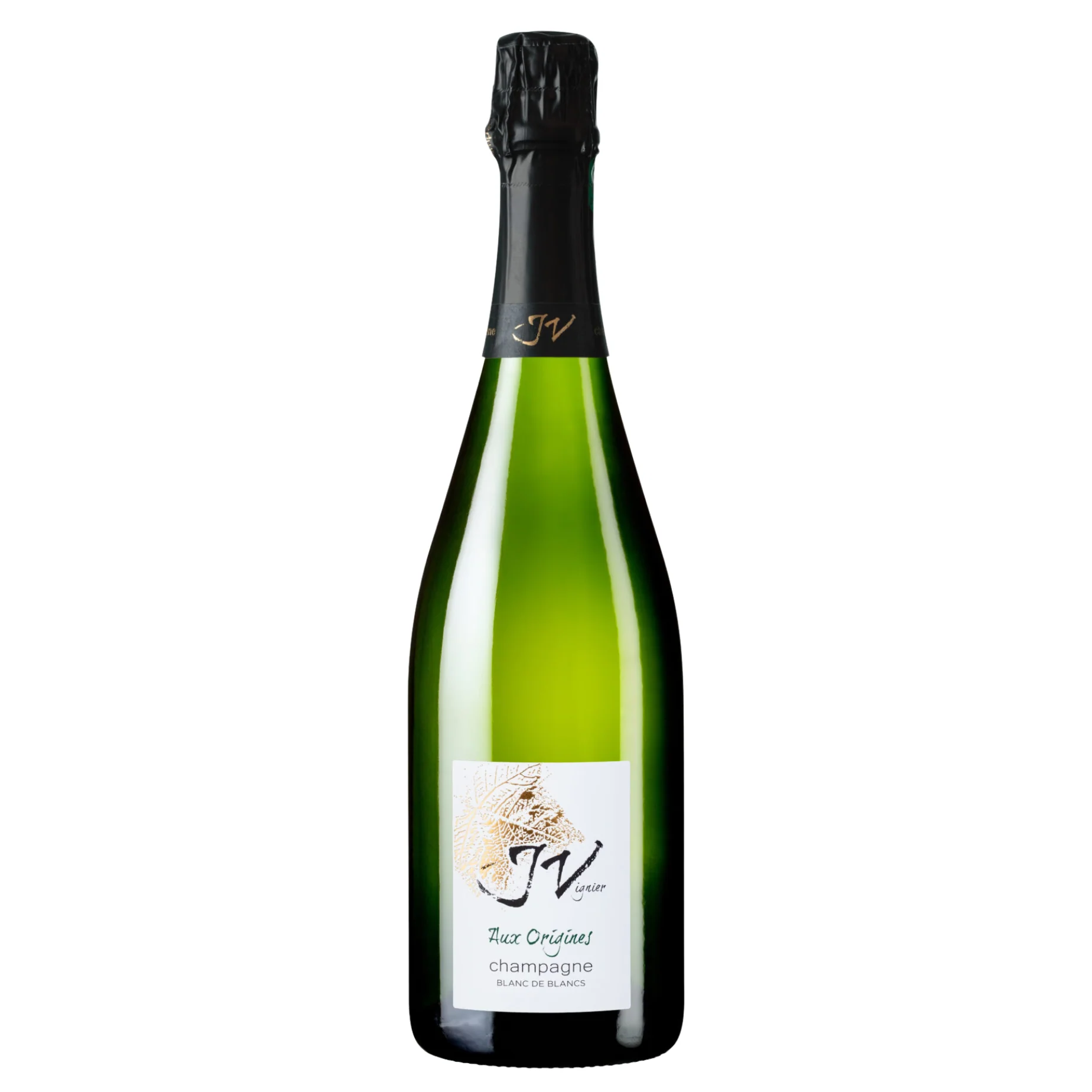
NV J. Vignier "Aux Origines" Blanc de Blancs Brut, Champagne, France
ABOUT THIS WINE
“Aux Origines” could be tanslated as “where it all began.” This blanc de blancs is made from the very first vineyards planted by Nathalie’s granparents, Marie-Louise and Paul, in Barbonne-Fayel, Côteaux Sézannais, in the 1960s. This cuvée is 100% Chardonnay, fermented in steel tanks with full malolactic conversion, bottled in April following harvest and aged 36 months prior to disgorgement.
All J. Vignier bottlings come from grapes hand picked at optimum maturity, whole-cluster pressed, with separation of first and second press juices, using only the first press. There is cold settling for clarification and slow fermentation at low temperatures with various selected yeasts. All base wines are fermented in stainless steel tank and go through malo, with several months of tank aging. Bottling for the second fermentation occurs in spring. An extraordinary minimum of 48 months (up to 8 or 12 years for some cuvées) bottle aging before disgorgement is a house requirement. Dosage is “Extra Brut” (5 g/L) for all wines. Vintage wines are made only in stellar years.
ABOUT THIS PRODUCER
The Vignier family history in Champagne dates to 1530, the time of Nicolas Vignier of Bars sur Seine. Nicolas was a physician, lawyer, theologian, and court historian for Henry III. His descendant, Nathalie Vignier, is now the tenth generation to pursue viticulture and winemaking in Champagne, and the sixth generation to do so in the grand cru village of Cramant, in the Côte des Blancs.
In the early 20th century, Nathalie’s grandfather, Paul LeBrun, had two hectares, taken over from his father, Henri LeBrun. Paul resolved to become an independent vigneron by separating himself from the big négociants after World War I and was among the first to do so in the Côte des Blancs. He established Champagne Paul LeBrun in the 1930s. Frank Schoonmaker — a long-time collaborator with Alexis Lichene in the wine trade, and together two of the most influential figures in shaping American views on European wine in the last century — was the first to import the wines to the U.S.
Nathalie and her brother, Jean, took over the domaine from their parents 12 years ago, with Jean on the business side and Nathalie in the vineyards and cellar. Nathalie’s husband Hubert Soreau (another Schatzi!) is the winemaker at Le Clos l’Abbé in Epernay. Through him, Nathalie and close family friend Sebastian Nickel (whose grandmother’s family farmed land around Sézanne and held plots that became AOC Champagne in the 1960s) made the connections that enabled them to realize a shared vision and dream — one with roots in Nathalie’s father’s profound understanding of the land. He had always told them there were “hidden treasures” in the 16.5 hectares of chardonnay in Côte des Blancs and Côte de Sézanne that constitute the Vignier LeBrun vineyards.
Product Information
Product Information
Shipping & Returns
Shipping & Returns
Description
ABOUT THIS WINE
“Aux Origines” could be tanslated as “where it all began.” This blanc de blancs is made from the very first vineyards planted by Nathalie’s granparents, Marie-Louise and Paul, in Barbonne-Fayel, Côteaux Sézannais, in the 1960s. This cuvée is 100% Chardonnay, fermented in steel tanks with full malolactic conversion, bottled in April following harvest and aged 36 months prior to disgorgement.
All J. Vignier bottlings come from grapes hand picked at optimum maturity, whole-cluster pressed, with separation of first and second press juices, using only the first press. There is cold settling for clarification and slow fermentation at low temperatures with various selected yeasts. All base wines are fermented in stainless steel tank and go through malo, with several months of tank aging. Bottling for the second fermentation occurs in spring. An extraordinary minimum of 48 months (up to 8 or 12 years for some cuvées) bottle aging before disgorgement is a house requirement. Dosage is “Extra Brut” (5 g/L) for all wines. Vintage wines are made only in stellar years.
ABOUT THIS PRODUCER
The Vignier family history in Champagne dates to 1530, the time of Nicolas Vignier of Bars sur Seine. Nicolas was a physician, lawyer, theologian, and court historian for Henry III. His descendant, Nathalie Vignier, is now the tenth generation to pursue viticulture and winemaking in Champagne, and the sixth generation to do so in the grand cru village of Cramant, in the Côte des Blancs.
In the early 20th century, Nathalie’s grandfather, Paul LeBrun, had two hectares, taken over from his father, Henri LeBrun. Paul resolved to become an independent vigneron by separating himself from the big négociants after World War I and was among the first to do so in the Côte des Blancs. He established Champagne Paul LeBrun in the 1930s. Frank Schoonmaker — a long-time collaborator with Alexis Lichene in the wine trade, and together two of the most influential figures in shaping American views on European wine in the last century — was the first to import the wines to the U.S.
Nathalie and her brother, Jean, took over the domaine from their parents 12 years ago, with Jean on the business side and Nathalie in the vineyards and cellar. Nathalie’s husband Hubert Soreau (another Schatzi!) is the winemaker at Le Clos l’Abbé in Epernay. Through him, Nathalie and close family friend Sebastian Nickel (whose grandmother’s family farmed land around Sézanne and held plots that became AOC Champagne in the 1960s) made the connections that enabled them to realize a shared vision and dream — one with roots in Nathalie’s father’s profound understanding of the land. He had always told them there were “hidden treasures” in the 16.5 hectares of chardonnay in Côte des Blancs and Côte de Sézanne that constitute the Vignier LeBrun vineyards.