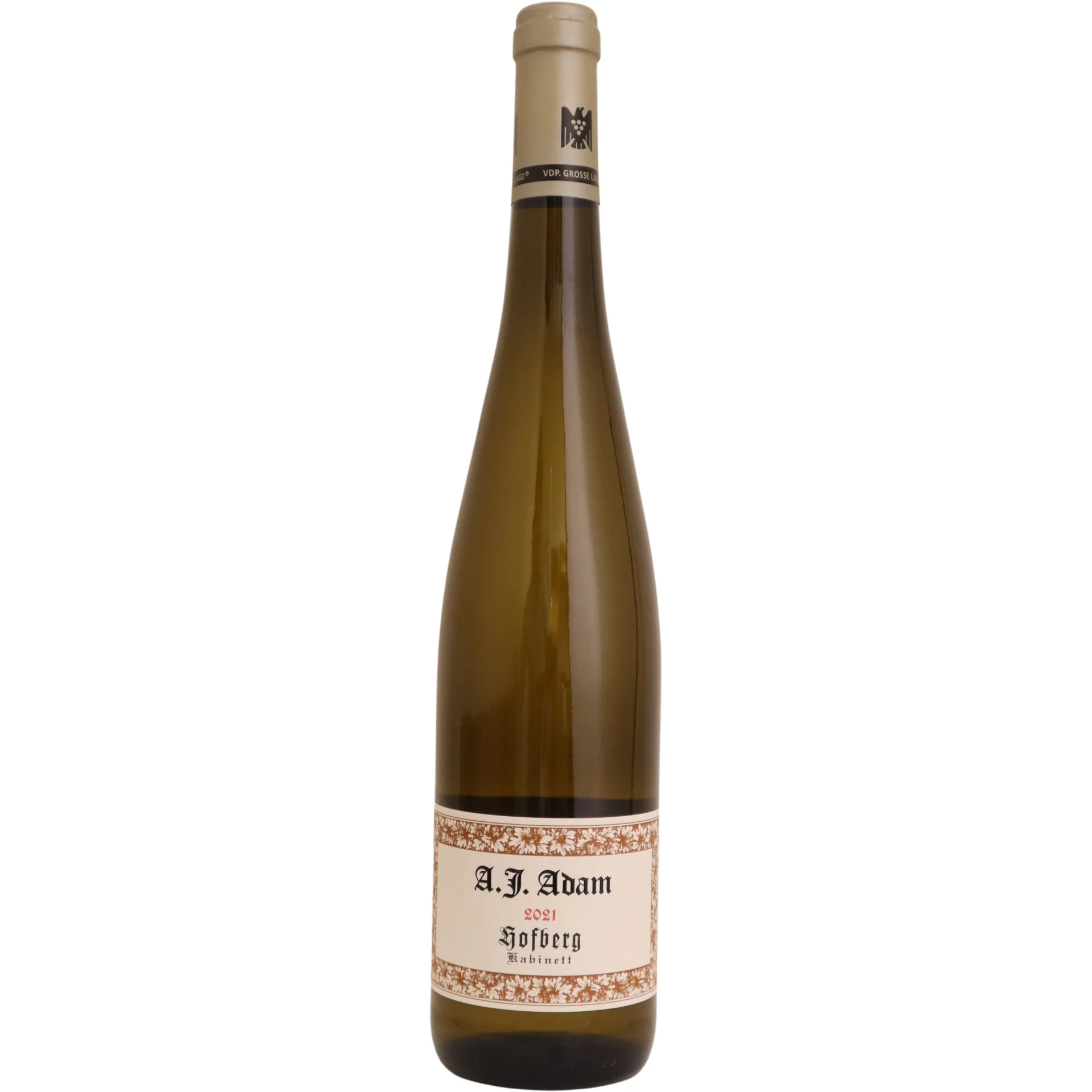
2021 Weingut A.J. Adam "Dhron Hofberg" Riesling Kabinett, Mosel, Germany
ABOUT THIS WINE:
The main part of the vineyards are situated on the Mosel river. But not the Hofberg. It's a lovely quiet side-valley on the Dhron river with weathered Devonian slate in mixture with quartzite. Riesling vines are 30 to 65 years old and some are still ungrafted.
ABOUT THIS PRODUCER:
Just south of Piesport in a small side valley lies the steep, south-facing vineyards of Dhron, named for a tributary of the Mosel. The Dhronerthal (Dhron Valley) is a small tributary of the Mosel, running south, just after Piesport. The steep, southwest-facing Hofberg was given the top rating in Clotten’s 1868 Vineyard maps. In the 1950s and ‘60s, the wines of Dhron Hofberg were famous, gracing the tables of fine restaurants. In the 1970s and ’80s, the new generation started to leave the vineyards and move to cities – a generation of Moslaners left their birthrights and many famous but small vineyards were left untended and became relics of the past. Growers in the village abandoned winemaking for work in larger cities, including Andreas’ parents. Adam re-started his family estate while still studying at Geisenheim University and interning at some of the great estates in Germany – Heymann-Löwenstein in the Wininngen, St. Urbans-Hof in Leiwen, and Van Volxem in the Saar. His first official vintage was in 2000 when he was just 21 years old, working a single hectare that was owned and farmed by his grandfather.
It was an area ripe for revitalization, as Andreas tells it: expanding with vineyard land in the Hofberg was “almost free” he says, paying less than 5 euros per square meter. “The sites were steep and very hard to work, so the land was very inexpensive. There was no demand because everyone had abandoned vineyards and Dhron didn’t have a famous name like Würtzgarten.” Andreas Adam is almost single-handedly responsible for bringing the Dhroner Hofberg back to its former status as one of the great Grand Crus of the Mosel.
Joined by his younger sister Barbara in 2013, after her graduation from Geisenheim and a stint at Keller in Rheinhessen, the estate has taken its place as one of the very finest estates in the Mosel. The two siblings work side by side and are responsible for vineyards and cellar together. Andreas & Barbara farm 45 separate parcels on the Hofberg, Häs’chen and Goldtröpfchen in Piesport, in a full spectrum of styles from dry to sweet. Recently they acquired vineyards in Häs’chen (.25ha) and additional land in the Piesporter Goldtröpfchen, specifically a site called Laychen. “Lay” is the old word for slate, and “chen” is the diminutive, referring to the small, broken slate soils here. The small new section of 700 square meters in Laychen was planted in 1908 and is completely ungrafted.
Harvest is always done by hand, with a heavy selection in the vineyards. The wines are fermented using only ambient yeasts in old fuder (around 1000 liters) and halbfuder (around 500 liters) and stainless steel. The wines are often left in contact with the lees for an extended period of time after natural fermentation, but nothing is done by rote at the estate.
There are no additions of any kind: no cultured yeast, enzymes and no süssreserve. Andreas says of his philosophy: “I sustain my vineyards by intensive soil work to bring out the essential nutrients up from the primary rock, the natural compost of a vineyard. This completion of the bond between elemental soil and the work of the vintner is another piece in the puzzle of terroir… I think in Germany we see terroir as a unity of grape, climate, soil, and the mentality of the person who works the vineyard. But the essence of that mentality is a knowledge that the geology of his terrain indeed creates the flavors in the grapes which grow there.”
Product Information
Product Information
Shipping & Returns
Shipping & Returns
Description
ABOUT THIS WINE:
The main part of the vineyards are situated on the Mosel river. But not the Hofberg. It's a lovely quiet side-valley on the Dhron river with weathered Devonian slate in mixture with quartzite. Riesling vines are 30 to 65 years old and some are still ungrafted.
ABOUT THIS PRODUCER:
Just south of Piesport in a small side valley lies the steep, south-facing vineyards of Dhron, named for a tributary of the Mosel. The Dhronerthal (Dhron Valley) is a small tributary of the Mosel, running south, just after Piesport. The steep, southwest-facing Hofberg was given the top rating in Clotten’s 1868 Vineyard maps. In the 1950s and ‘60s, the wines of Dhron Hofberg were famous, gracing the tables of fine restaurants. In the 1970s and ’80s, the new generation started to leave the vineyards and move to cities – a generation of Moslaners left their birthrights and many famous but small vineyards were left untended and became relics of the past. Growers in the village abandoned winemaking for work in larger cities, including Andreas’ parents. Adam re-started his family estate while still studying at Geisenheim University and interning at some of the great estates in Germany – Heymann-Löwenstein in the Wininngen, St. Urbans-Hof in Leiwen, and Van Volxem in the Saar. His first official vintage was in 2000 when he was just 21 years old, working a single hectare that was owned and farmed by his grandfather.
It was an area ripe for revitalization, as Andreas tells it: expanding with vineyard land in the Hofberg was “almost free” he says, paying less than 5 euros per square meter. “The sites were steep and very hard to work, so the land was very inexpensive. There was no demand because everyone had abandoned vineyards and Dhron didn’t have a famous name like Würtzgarten.” Andreas Adam is almost single-handedly responsible for bringing the Dhroner Hofberg back to its former status as one of the great Grand Crus of the Mosel.
Joined by his younger sister Barbara in 2013, after her graduation from Geisenheim and a stint at Keller in Rheinhessen, the estate has taken its place as one of the very finest estates in the Mosel. The two siblings work side by side and are responsible for vineyards and cellar together. Andreas & Barbara farm 45 separate parcels on the Hofberg, Häs’chen and Goldtröpfchen in Piesport, in a full spectrum of styles from dry to sweet. Recently they acquired vineyards in Häs’chen (.25ha) and additional land in the Piesporter Goldtröpfchen, specifically a site called Laychen. “Lay” is the old word for slate, and “chen” is the diminutive, referring to the small, broken slate soils here. The small new section of 700 square meters in Laychen was planted in 1908 and is completely ungrafted.
Harvest is always done by hand, with a heavy selection in the vineyards. The wines are fermented using only ambient yeasts in old fuder (around 1000 liters) and halbfuder (around 500 liters) and stainless steel. The wines are often left in contact with the lees for an extended period of time after natural fermentation, but nothing is done by rote at the estate.
There are no additions of any kind: no cultured yeast, enzymes and no süssreserve. Andreas says of his philosophy: “I sustain my vineyards by intensive soil work to bring out the essential nutrients up from the primary rock, the natural compost of a vineyard. This completion of the bond between elemental soil and the work of the vintner is another piece in the puzzle of terroir… I think in Germany we see terroir as a unity of grape, climate, soil, and the mentality of the person who works the vineyard. But the essence of that mentality is a knowledge that the geology of his terrain indeed creates the flavors in the grapes which grow there.”