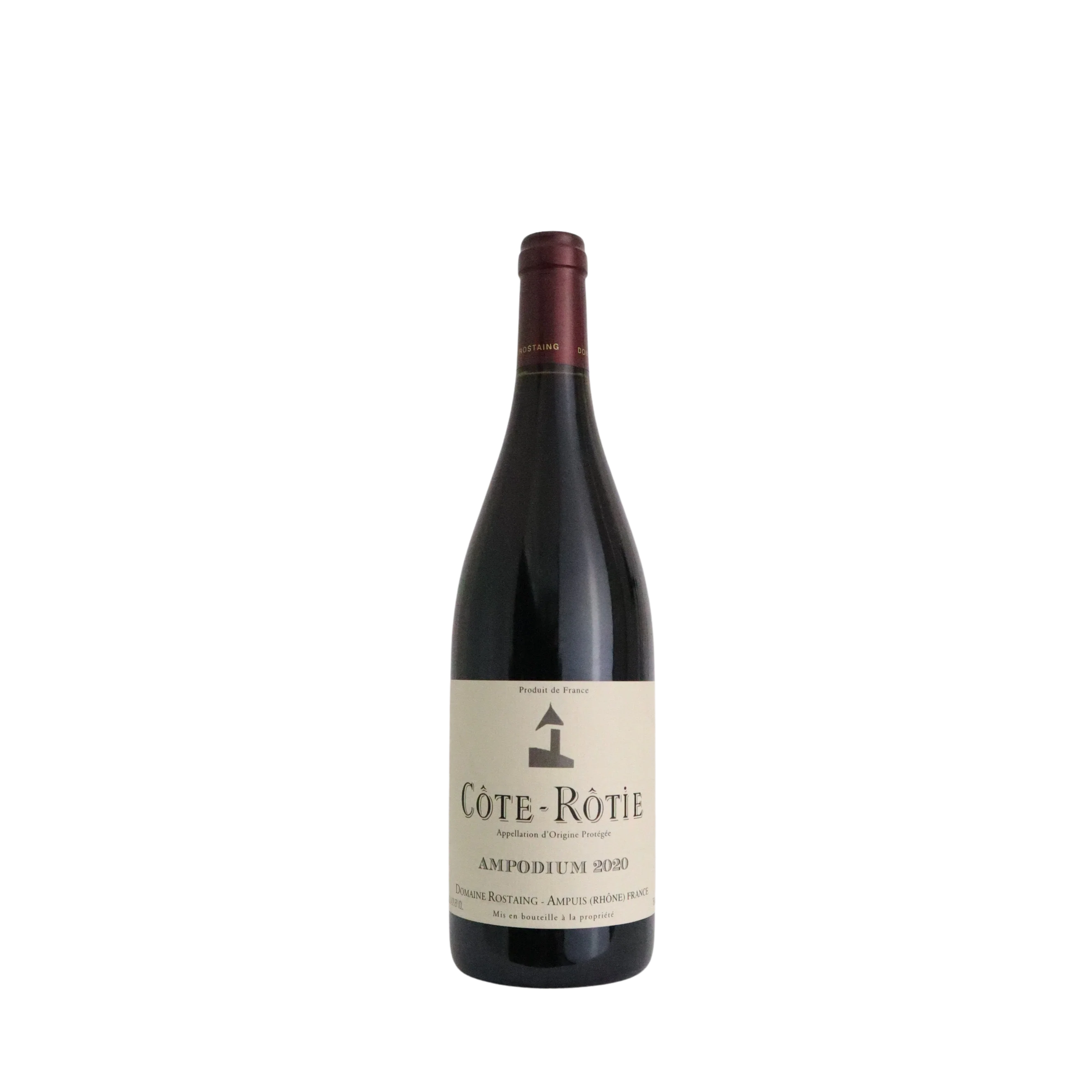
2023 René Rostaing Côte-Rôtie "Ampodium", Rhone Valley, France
ABOUT THIS WINE
The flagship red, Ampodium (formerly known as “Classique”), is assembled from parcels throughout Côte Rôtie. It is a terrific expression of the appellation, and by itself can rival some of the appellation’s best.
Winemaking follows the classical model. Up to 100% of the stems are used depending on vintage and ripeness. An extended, gentle maceration is followed by aging in a mix of pièce and demi-muid, with only about 10-15% new.
THIS PRODUCER
The Rostaing estate dates to 1971 when René Rostaing– a Notary by trade – began tending a few plots of family vineyards. He had the perfect role model to guide him into a career of classical winemaking: Marius Gentaz, his uncle. Over the next few years, René took advantage not only of his uncle’s mentoring, but of historically low vineyard prices, to acquire a prized half acre each in the Côte Blonde and La Landonne lieux-dits.
And when he married, he acquired a second traditional role model, his father-in-law, Albert Dervieux. Dervieux retired in 1989 and Gentaz followed three years later, giving René a further ten acres of very old vines in some of the appellation’s top sites. This treasury of vineyards launched René’s estate into the stratosphere.
The vineyard expansion also enabled René to quit his day job and to devote himself full time to winemaking. Over the next 25+ years, he crafted a sequence of masterful wines that honored the legacy of his illustrious forebearers.
In 2015, René’s son, Pierre, took the reins at an estate that boasts 20+ acres of the finest vineyards in and around Côte Rôtie. And, he shares his father’s deep reverence for Côte Rôtie’s traditions.
Always the maverick, René was never afraid to use technology if it would help him make even more authentic Côte Rôtie. So, in the late 1990s, René acquired horizontal, rotary fermentation tanks, though not for the same purpose as virtually everyone else.
While modernists—most famously in Barolo—adopted these tanks to speed fermentations and capture more color and fruit, René adopted them to mimic the long, gentle macerations of his ancestors. The process has much the same effect as the cappello sommerso employed by many of Piedmont’s staunchest traditionalists, with the tanks often making just a single rotation per day.
The Rostaings also prize mature fruit, but never to a degree of over-ripeness. For example, if you’re looking for 2003 or 2009 Northern Rhônes with no hint of sur-maturité, there are no better choices than Rostaing Côte Rôties.
Over his long career, René experimented with other “modern” techniques, but the results convinced him to reject the vast majority as antithetical to Côte Rôtie’s essence. The classical regime that the estate employs today would certainly be recognized by their ancestors. Pierre was able to experiment further through stages in Washington, California and in France. He too came away convinced of the wisdom of his forebearers.
Pierre uses up to 100% of the stems - believing they contribute to Côte Rôtie’s ineffable perfume. Macerations last from 7 to 20+ days, and the wines enjoy a long élevage in a mix of barrels and time-honored pièce for aging, so that no more than 15% of a given vintage sees new wood.
In sum, the Rostaing wines rank—in our view and the view of others—among the very best of classic Côte Rôtie. They are wines of consistency and sophistication that are true to their origins. And with Pierre Rostaing now in day-to-day control, the future for this estate has never looked brighter.
Original: $111.99
-65%$111.99
$39.20Product Information
Product Information
Shipping & Returns
Shipping & Returns
Description
ABOUT THIS WINE
The flagship red, Ampodium (formerly known as “Classique”), is assembled from parcels throughout Côte Rôtie. It is a terrific expression of the appellation, and by itself can rival some of the appellation’s best.
Winemaking follows the classical model. Up to 100% of the stems are used depending on vintage and ripeness. An extended, gentle maceration is followed by aging in a mix of pièce and demi-muid, with only about 10-15% new.
THIS PRODUCER
The Rostaing estate dates to 1971 when René Rostaing– a Notary by trade – began tending a few plots of family vineyards. He had the perfect role model to guide him into a career of classical winemaking: Marius Gentaz, his uncle. Over the next few years, René took advantage not only of his uncle’s mentoring, but of historically low vineyard prices, to acquire a prized half acre each in the Côte Blonde and La Landonne lieux-dits.
And when he married, he acquired a second traditional role model, his father-in-law, Albert Dervieux. Dervieux retired in 1989 and Gentaz followed three years later, giving René a further ten acres of very old vines in some of the appellation’s top sites. This treasury of vineyards launched René’s estate into the stratosphere.
The vineyard expansion also enabled René to quit his day job and to devote himself full time to winemaking. Over the next 25+ years, he crafted a sequence of masterful wines that honored the legacy of his illustrious forebearers.
In 2015, René’s son, Pierre, took the reins at an estate that boasts 20+ acres of the finest vineyards in and around Côte Rôtie. And, he shares his father’s deep reverence for Côte Rôtie’s traditions.
Always the maverick, René was never afraid to use technology if it would help him make even more authentic Côte Rôtie. So, in the late 1990s, René acquired horizontal, rotary fermentation tanks, though not for the same purpose as virtually everyone else.
While modernists—most famously in Barolo—adopted these tanks to speed fermentations and capture more color and fruit, René adopted them to mimic the long, gentle macerations of his ancestors. The process has much the same effect as the cappello sommerso employed by many of Piedmont’s staunchest traditionalists, with the tanks often making just a single rotation per day.
The Rostaings also prize mature fruit, but never to a degree of over-ripeness. For example, if you’re looking for 2003 or 2009 Northern Rhônes with no hint of sur-maturité, there are no better choices than Rostaing Côte Rôties.
Over his long career, René experimented with other “modern” techniques, but the results convinced him to reject the vast majority as antithetical to Côte Rôtie’s essence. The classical regime that the estate employs today would certainly be recognized by their ancestors. Pierre was able to experiment further through stages in Washington, California and in France. He too came away convinced of the wisdom of his forebearers.
Pierre uses up to 100% of the stems - believing they contribute to Côte Rôtie’s ineffable perfume. Macerations last from 7 to 20+ days, and the wines enjoy a long élevage in a mix of barrels and time-honored pièce for aging, so that no more than 15% of a given vintage sees new wood.
In sum, the Rostaing wines rank—in our view and the view of others—among the very best of classic Côte Rôtie. They are wines of consistency and sophistication that are true to their origins. And with Pierre Rostaing now in day-to-day control, the future for this estate has never looked brighter.